A place to share books, music, techniques, and all things related to bilingual storytime!

Wednesday, July 13, 2011

A BIG Idea for Building Early Literacy - ¡Elefantes!

Tonight in Bilingual Family Storytime we are sharing animal stories, songs and activities, including Petr Horacek's Elefante, also available in English as Elephant.  This is a great story about using our imaginations to have fun, and it uses text in some cool ways.  Here's an example of how to communicate the value of unusual text for building early literacy to parents while introducing the book:

"Our first book, Elephant by Petr Horacek, uses various shapes and directions in the text, which helps children learn that when we use books, we read from left to right.  This is an important skill called print utilization that helps prepare young children to learn to read.

El primer libro, Elefante por Petr Horacke, cambia mucho las formas y direcciones en el texto.  Esto ayuda a los niños a aprender que cuando usamos libros, leemos desde la izquierda a la derecha.  Esta es una habilidad importante que se llama el reconocimiento de la palabra escrita que prepara a los niños a aprender a leer."

I found an awesome song on YouTube by Habla Blah Blah called "Los elefantes" that we are going to use too.  We will count and stomp along with the song, which would be super easy to sing again in English.  We may even get out some rhythm sticks!  This will be a great chance to bring out my very favorite Folkmanis elephant puppet to come out and play too!

Can't wait to share these ideas and more with all of our amigos tonight at 6 PM at the Village Branch library!

UPDATE!
One of my co-presenters (the amazing Freda Mosquera) at the "Growing Up Bilingual Programming: A Tribute to Rose Treviño" session at the Reforma IV conference last Septmber, shared a very cool way in which she uses the traditional "Elefantes" song in her program.  I have since done this in my programs and it is so much fun!  Take a piece of string or yarn as your telaraña and have paper elefantes for each child.  I have numbered each of my elefantes 1-10.  Then have the children come up one at a time to add their elefante to the telaraña with a clothespin.  Number one comes up first and adds her elephant and then takes the end of the yarn to sing the first verse of the song and call over elefante dos.  This is interactive and engaging, so it works for mixed ages.  It uses a traditional rhyme, familiar to both Spanish-speaking and English-speaking communities, which makes it very powerful for reinforcing the development of phonological awareness.  Finally, it also helps to practice counting skills and number identification, two essential school readiness skills.  Have fun adding this to your programs!
The super librarians of Flannel Friday have a flannel, the words in both languages and a video of the song in Spanish all available here.

Thursday, June 16, 2011

P is for Piñata: A Mexican Alphabet - How did I miss this?!

Walking through the library yesterday I came across what I was sure was a brand new book - P is for Piñata: A Mexican Alphabet by Tony Johnston (who also wrote My Abuelita) and illustrated by John Parra.  I was shocked to find this book has actually been around since 2008!  As disappointed as I am that I haven't been using this spectacular alphabet book in my storytimes up to this point, I am so excited to start using it now!

This book presents each letter of the alphabet and a corresponding object or concept from Mexico in a short rhyming poem, written in English with some Spanish words.  Because of the rhyming text, the beautiful, full-page illustrations and the simplicity of the concepts presented, this is a great alphabet book to share with preschool groups.  Additionally, a sidebar shares more sophisticated information about the history or use of each letter's object, which makes this a great book for a classroom lesson on Mexico or for older readers to explore on their own.  I will be using this book in September when our Bilingual Family Storytime group celebrates the beginning of Hispanic Heritage Month.

My favorite letter in the book is "S" for, of course, Skeleton!

     "S is for Skeleton
      Skeleton, skeleton, why do you dance?
      I love to move.  I love to prance -
      sometimes with partners; sometimes alone -
      to show off my rackety, clackety bones."

So if you are like me, and somehow have missed this amazing book, go find it and add it to your collection ASAP!  Know of another great book for bilingual programming that I may have missed?  Share it here!

Thursday, March 24, 2011

¡Listos para Kindergarten! Ready for Kindergarten!

We are all about working closely with the Fayette County Schools at the Lexington Public Library to promote Kindergarten readiness - sharing with families the skills their kids need to be successful when they start school, and modeling fun, interactive ways in which they can practice this at home.  Last year, a colleague of mine, Susan Price at the Central Location, took this mission and used it to develop a brilliant program called "When I'm in Kindergarten."  This is a discovery center style program, much like "Little Hands, Big Ideas / Manos pequeñas / Ideas grandes."  In every station, parent and child explore important Kindergarten readiness and pre-literacy skills, such as their personal information, parts of the body, practicing numbers, sorting objects by color and size and alphabet letters.  Last year I translated this program, and we have offered it twice so far at the Villlage Branch.  With Susan's permission, in this post I will share all of the materials you need to put this program on bilingually at your library too!  The instructions for the walls are available in English and in Spanish.  However, both were originally created in Microsoft Publisher, so to access via Google Docs, you will need to download and open with Publisher.  If this is a problem for any reason, please feel free to contact me via the blog and I can email to you as an attachment.
  1. Patterns / Sequencias
 In this station, foam shapes are set out on a mat.  We use the Mother Goose Foam Shape and Pattern Blocks, but this could also be done on the cheap with paper cutouts.  Parents work with the child to identify the various shapes and their colors.  The caregiver then helps the child construct the patterns depicted in the instructions, and the child predicts which shapes will come next to continue the pattern.  Children who master this can then be challenged to create and extend their own patterns.  This stations helps develop Letter Knowledge by practicing shapes, as well as the Kindergarten readiness skills of identifying shapes and colors and extending simple patterns.

2.  Telephone / Teléfono

This is probably my favorite station!  Large numbers are laminated and glued to a mat in the shape of a phone pad.  The caregiver helps the child practice important phone numbers (such as home, cell and 911) by hopping from number to number!


3.  Laundary / Lavando la ropa
This station practices sorting objects by various attributes, such as color and shape.  A small clothesline is hung to the wall to which children can clip laminated paper cutouts of articles of clothing in assorted colors.  For example, they can group all of the shirts, or all of the red clothes.

4.  Body Parts / Partes del cuerpo
Another important station!  Susan made and laminated a large cutout of a child.  The names of various body parts are laminated and attached to magnets which correspond to magnets on the body parts too.  Children match the name to the appropriate area of the body.  This activity would be fun to include in a body or movement themed storytime.  You could follow up with a movement song that practices body parts, such as "Head, Shoulders, Knees and Toes" or "Juanito."


5.  Personal Information / Información personal
Through this activity, children and caregivers go over important personal information children need to know, particularly in the event of an emergency, such as family members' names, address and birthday.  Parents review this information with their child in the form of a mad lib (available in English and Spanish).  They also use dry erase markers to complete the missing information from the drawn and laminated house.

6.  Alphabet Soup / La sopa de letras
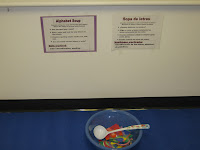
At this station, children find a big bowl of letter soup, made from paper letters, cut and laminated.  Caregivers help children find the letters in their names and dip out the whole alphabet in order.

In order to continue the fun and learning outside of the library, Susan also made two take-home activities: an obstacle course and a grocery hunt.  We are sure to also share with parents the information from FCPS regarding what children are expected to know as they enter Kindergarten. 

Let me know if you use any or all of these stations to supplement storytimes or create new programs.  Do you have other Kindergarten readiness programming ideas?  Share them here / compártanlos aquí!

Wednesday, March 16, 2011

Storyblocks by Colorado Libraries for Early Literacy


Colorado, way to go!  First of all, "Colorado Libraries for Early Literacy" is a brilliant statewide initiative.  Second, I love Storyblocks!  Storyblocks is a website for parents, caregivers, etc. with lots of age-appropriate videos in English and Spanish of librarians demonstrating rhymes and songs to share with little ones, helping them develop vocabulary and phonological awarenes.  This website is awesome.

I will be in Denver, CO in September for the REFORMA 4th National Conference, presenting a preconference workshop on bilingual programming for various ages with a panel of librarians from across the country.  I will love to meet with other librarians in or near Denver, or attending the conference, who are serving Latino families, offering bilingual programs, or promoting early literacy to Spanish-speaking parents.  It is always so invigorating to hear the creative ways in which others are making an impact!

What are other libraries and librarians doing in a visible way to promote early literacy and empower parents?

Sunday, March 6, 2011

NPR Story on Benefits of Bilingualism

For anyone out there raising bilingual babies, this story from Science Friday is definitely worth a listen!  This really hits home the importance of reassuring parents who may be wary of confusing or harming their child's development by speaking "too much" in their native language, that sharing language with your child is a gift and a key to culture - not too mention an extremely valuable skill to have at one's disposal later in life.

http://www.npr.org/2011/02/25/134059279/being-bilingual-not-only-a-boon-for-native-tongues

Monday, February 28, 2011

McConnell 2011!

What a great McConnell Conference the UK School of Library and Information Science put together this year!  Sharon Draper lifted our spirits with her amazing energy, Rafael López shared his dazzling colors and artistic process, and Matt de la Peña illuminated and inspired with his own personal story.  It was truly an honor and a joy to present at this conference.

I was thrilled by the questions and ideas shared during both of my sessions.  Here are some of the ideas that participants shared that they were planning to take back to their libraries.  I have added some of my own comments to these in asterisks:

  • Start planning a Día celebration for the first time.  *LOTS of folks said this, which is wonderful!  Don't forget that Reforma Southeast is accepting applications for two mini-grants for folks planning Día programs.*
  • Access websites for Survival Spanish and translations of library policies.
  • Contact services in my county that serve Latinos to ask about the materials they need, the programs they would participate in, and ways to reach Latinos in my community.  *This is great!*
  • I am an elementary school librarian.  I can contact the local public library to collaborate with them to build a stronger Latino program in my school.
  • Staff training about using folktales as part of programming to Latino communities.  *Conejito by Margaret Read MacDonald and Martina, the Beautiful Cockroach by Carmen Agra Deedy are two great books to start with.  The Bossy Gallito by Lucia Gonzalez also makes a great flannel story!*
  • Check out Webjunction resources and share them with others at my library.  *Consider their Spanish Language Outreach training, which is available online.*
  • Welcome Latino families into our school with warmth and a smile.  *I LOVE this one!*
  • Start homework help if possible - helps total constituency.  *Great point!*
  • Add more multicultural / bilingual books to storytime.
  • Contact with Spanish liaison at school to schedule a library tour for local Latino families.  *Fantastic idea!*
  • Start a Noche de Cuentos evening program.
  • Purchase more bilingual books.
  • Have high school students taking Spanish do bilingual storytelling, giving them volunteer hours and giving the children role models.  *Love this idea!  There are lots of great books and stories out there that incorporate little bits of Spanish into English text.  This might be a great place to start, so that it is not too overwhelming for the high schoolers.  I recommend Susan Middleton Elya and Ann Whitford Paul to get you started.*
Mil gracias to everyone who attended my sessions at the McConnell for sharing these ideas.  Keep us posted with how things are going for you by leaving a comment or sending me an email.  Also, if you have any questions along the way, please know that I am always happy to help.  You aren't alone!  Reforma Southeast is here for you too!

Thursday, February 17, 2011

Serving Latino Children and Families in Kentucky Libraries

On February 25 and 26, 2011, I will be sharing this presentation at the McConnell Conference in Lexington, KY.  By clicking below, you can access the entire PowerPoint.  The two accompaning handouts are also available at http://www.slideshare.net/KatieCunningham, as well as past presentations.