Libraries often strive to be apolitical, in order to allow everyone to feel welcome. However, in 2018 and beyond, it is impossible to discuss the real challenges libraries face in reaching and serving Latino and Spanish-speaking communities without acknowledging politics. The rhetoric used to describe immigrants in general, and Latinos in specific (both citizens and immigrants) during the 2016 election campaign, and the policies enacted by the Trump administration, have real-world consequences that increase the challenges of providing quality library service to these communities. Strategy and relationships are more important than ever.
Building Relationships, Building Bridges has been updated to reflect these realities. Drawing from current research and front-lines, this workshop works to develop best practices for respectful and responsive outreach. Emphasis is particularly placed on serving first-generation, primarily Spanish-speaking, Latino immigrants and their families.
This workshop is being next offered online through Library Juice Academy in February. For more information and registration details, please visit the LJA workshop page.
How has your outreach to Latinos and Spanish-speakers changed in the last year? What information needs are most pressing for the communities you are serving?
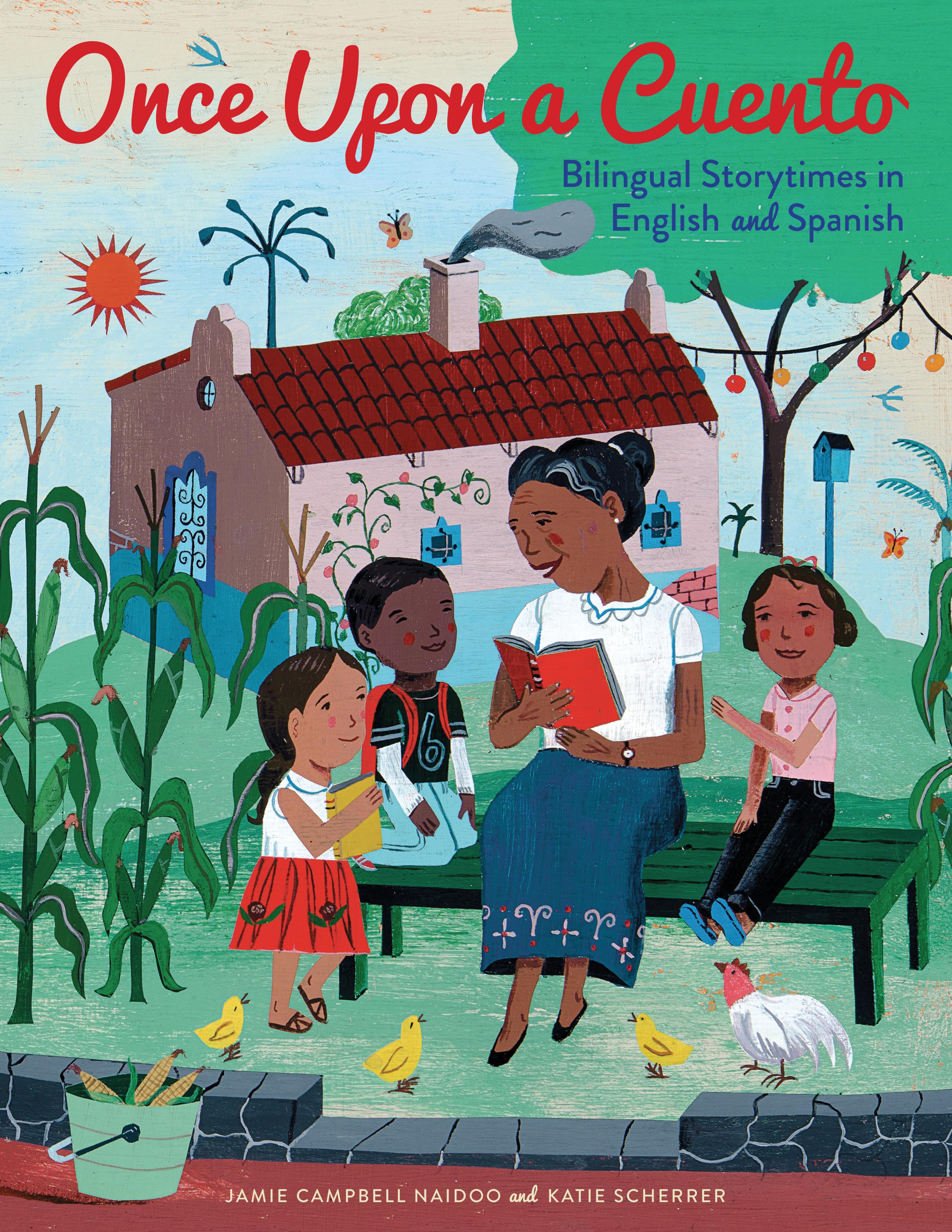
Once Upon a Cuento: Bilingual Storytimes in English and Spanish, co-authored by Jamie Campbell Naidoo and me, just received a STARRED review from School Library Journal yesterday! Such an honor. It am thrilled to know that this book is achieving its intended purpose: making the case for the need for bilingual (and Spanish-language) programming for young children, guiding library staff step-by-step through the process of outreach to Latinx families, and increasing exposure among anyone who works with young children to the vibrant world of Latinx children's literature. Does your library have a copy yet?
Once upon a Cuento: Bilingual Storytimes in English and Spanish by Jamie Campbell Naidoo & Katie Scherrer | SLJ Review
Get the latest SLJ reviews every month, subscribe today and save up to 35%.
NAIDOO, Jamie Campbell & Katie Scherrer. Once upon a Cuento: Bilingual Storytimes in English and Spanish. 136p. further reading. index. ALA Editions. May 2016. pap. $48. ISBN 9780838914113.
This thorough introduction not only gives guidance on how to organize and conduct a bilingual storytime but also details how to do effective outreach to Latinx communities. The book is half manual and half ready-to-use bilingual programs for toddlers, preschoolers, and mixed-age and family groups. The thematic, language-rich plans include songs, finger plays, and extension activities and revolve around titles written by Spanish and Latin American authors and representative of Latino cultures. The how-to section on outreach is chock-full of practical advice on programming and book and app selections. The authors feature real-life examples of librarians visiting community organizations and meeting trusted members of Latinx communities in order to communicate the library’s mission. The authors emphasize the importance of “[embedding] the library as a valued and trusted community service.” Included are literacy maxims in both languages and myths surrounding second language learning. Practical information on how to find and select a bilingual partner and how librarians who are not bilingual can run such programs give this text a greater readership. Much of the advice can be applied to any language group, and an extensive resource list is included. VERDICTEssential for both public and school librarians who serve the many diverse ELL populations living in the United States.–Sara Lissa Paulson, City-As-School High School, New York City
This review was published in theSchool Library JournalNovember 2016 issue.
Hi all! As you may or may not know, I recently co-authored a book (along with Dr. Jamie Campbell Naidoo) published earlier this year by ALA Editions on bilingual storytime programming, titled Once Upon a Cuento: Bilingual Storytimes in English and Spanish. I'd love to share with you a recent review of the book, written by Martín Blasco and published by Webjunction. You can find the whole review here - www.webjunction.org/news/webjunction/book-review-once-upon-a-cuento.html.
What I most appreciate about this review is that it is written from the point of view of a bilingual storytime "skeptic." Martín is the founder of Reforma Oregon, and an ardent supporter of monolingual Spanish storytime, due to its benefits for immersing families in early literacy practices in the language they know best. He was concerned that our book would claim that bilingual storytime is "better" than monolingual Spanish storytime. He was so pleasantly surprised to find out that this is not our objective at all! In fact, we highlight a librarian who presents Spanish storytime in her library and bilingual storytime at her local school, because that is what is needed by her local community. And that, really, is our point.
This resource is not about dogma or pitting those who present bilingual storytime and monolingual storytime against one another. It is about knowing your community, being involved with local Latino community organizations and partner agencies in meaningful ways, setting up a storytime that works best for your community given the resources you have available, possessing a depth of knowledge of high-quality Latino children's literature, and making purposeful use of the digital resources that are available for Latino and Spanish-speaking families. Yes, we love bilingual storytime! And we hope that you love it too! We also know that different communities are going to make different choices about what style of storytime works best for them, and we make plenty of space for that. But in this day and age, there is no excuse for any library not making the effort to serve the Latino and Spanish-speaking members of their community. There is no excuse for not being aware of the high-quality Latino children's literature that is available and making use of it in your programs and including it in your collections. There is just no excuse. So wherever your library is in its journey toward inclusion of Latino and Spanish-speaking families, it is our hope that this resource can help you keep moving a little more forward.
Finally, I'd like to share that the LAST CHANCE of 2016 to learn about bilingual storytime and outreach to Latino families with me begins October 3. I am currently expecting my first child, and plan to take some time off early next year. At this stage, I'm not sure when I will be travelling for in-person training and setting up online training sessions again, but I would venture to guess that it will be late spring of 2017 at the earliest. So if you are interested in exploring these topics with me, let's do it next month!
The great news is that this upcoming class is the best bang for your buck of all of the online classes that I teach. The Library of Virginia is offering "Bilingual Storytime and Latino Outreach" from October 3 - November 11. This six-week, asynchronous, online class uses Once Upon a Cuento: Bilingual Storytimes in English and Spanish, along with recorded presentations, videos, additional readings, and online conversations to go in-depth in exploring outreach to Latino communities and bilingual storytime development. You can learn more about the class and register here - www.eventbrite.com/e/library-outreach-and-bilingual-storytime-tickets-26122450954. Let me share some key points about why this class is such a great deal:
The cost is only $30 for Virginia library staff and only $50 for library staff in other states!
Your registration fee includes a copy of Once Upon a Cuento: Bilingual Storytimes in English and Spanish. The book normally sells for $48, so this is like buying the book and getting the course for free!
There are three phone conference opportunities throughout the class, which provide you the chance to talk with me and your cohorts about bilingual storytime, outreach, and related topics in real time.
The course covers BOTH outreach and bilingual storytime. Typically I teach these topics separately, so this is like getting two classes (plus the book!) for the price of one!
Even if you've taken a class with me in the past, I hope you'll consider joining me for this last session of 2016. This specific class is my favorite to teach, as we really get to dig into these topics and get to know one another over the course of our time together. As always, be in touch if you have questions. I hope to interact with lots of you soon!
Yes, the time has finally arrived. Once Upon a Cuento: Bilingual Storytimes in English and Spanish (co-authored by Jamie Campbell Naidoo and myself) is available for purchase in the ALA Store! I have to say, I am so proud of how this manual turned out. It is a complete guide for library staff on how to develop and implement a bilingual storytime program. Chapters focus on making the case for the need for bilingual storytime programs, conducting outreach to Latino communities, strategies for presenting bilingual storytime when you do not speak Spanish yourself, various formats and styles of presenting bilingual storytime, and using digital media in bilingual storytime settings. This is followed by 18 ready-to-use bilingual storytime plans and an extensive resource section that guides readers to useful books, music and online sources. If you are interested in bilingual storytime, this manual will help you find your way!
It should be noted that this manual can be used by librarians offering monolingual storytimes as well. If you are interested in Spanish-only storytime, the outreach guide, program plans, and resources will help you find your audience and design your programs. If you are interested in English-only storytimes, you will learn about excellent Latino authors and illustrators you can include in your programs, and what options are available to you to help make your programs more inclusive of Latino and Spanish-speaking families. There is truly something for everyone.
In celebration of its publication, I am giving away one copy of this title. Next month (August), I will be offering my final session of 2016 of "Bilingual Storytime at Your Biblioteca" through Library Juice Academy. This is a four-week, asynchronous online class in which participants will learn the details of and find helpful resources for planning and presenting bilingual storytime programs. Everyone who participates in this session of the workshop will be entered into a drawing for a free copy of Once Upon a Cuento. Find more information about the workshop and full registration details here - http://libraryjuiceacademy.com/033-storytime-biblioteca.php. If you've been thinking about taking this workshop but have not yet had the chance, now is the time to join us! I hope to see many of you in the group next month!
Recently I discovered two wonderful resources that I have to share with you all - stORytime and "Beyond Bilingual Storytime and ESL," a presentation from this year's recent PLA conference.
stORytime
StORytime is "a new early learning initiative created with the help of communities across Oregon with an investment from the state legislature. The initiative brings together parents, educators, Early Learning Hubs, Regional Achievement Collaboratives, libraries, local businesses, and culturally specific community partners to build awareness and shared responsibility for ensuring our youngest Oregonians are on track to read by third grade." I love this resource because it is all about empowering families AND...they have lots of great resources available in Spanish! Materials in Spanish include suggested early literacy activities for families, printable handouts and more. Great job Oregon!
"Beyond Bilingual Storytime and ESL"
A colleague who attended PLA in Denver shared the information from this session with me, and it is fantastic. It's all about outreach, and the presentation and outreach planning guide available on the session page clarify some extremely valuable points about outreach to Latino communities. For example, there isn't one "Latino" community! They also point out why traditional models of program development don't really work for underserved communities and propose a different, community-focused strategy. It's great work, and I highly recommend you check it out. Way to go Adriana (Ady) Huertas, Zoe Jarocki, and Simone Groene-Nieto.
What great resources have you come across lately that help you in service to Latino and Spanish-speaking children and families? Share them with us here!
Hi all! First, I want to apologize that this blog has in many ways become a channel for self-promotion. I realize that I am doing a less than stellar job at keeping it up-to-date with fresh bilingual storytime programming content. The simple fact is that there are only so many hours in the day, and (like everyone else) I do the best that I can to keep up! I am very fortunate that a number of new opportunities have found their way into my life, and currently, this blog is much further down on the priority list than some of my other responsibilities. But, it's still one of the best tools that I have to let you know when I am offering training and other professional development opportunities, so that's what I am often sharing. I do feel bad that I'm not giving you more...so that has inspired a giveaway! Read on to the bottom of the post for more information.
There are lots of professional development opportunities happening with me this spring. On March 7, my four-week workshop "Building Relationships, Building Bridges: Library Outreach and Marketing to Latino and Spanish-Speaking Families" starts through Library Juice Academy. It is very common that libraries struggle to connect with Latinos and Spanish-speakers, particularly first-generation immigrant communities. This workshop helps participants explore potential barriers to access and how to overcome them. We focus on outreach, identifying and working with community partners, and marketing/advertising. I strongly recommend this course for anyone who is considering launching a bilingual storytime program, especially if you are hoping this storytime will help attract new library users from the Latino community. It's also useful for library staff in adult services, outreach, administration or any library department looking for strategies to improve relationships among the Latino and Spanish-speaking community.
I also have two ongoing workshops on bilingual storytime that I offer through Northern Kentucky University. One is a workshop for library staff who are themselves bilingual, the other is a workshop for library staff who are not bilingual. Each explores the fundamentals of bilingual storytime programming, but they are presented differently, as the ways in which bilingual/nonbilingual staff will go about designing and implementing bilingual storytime are different. These workshops are entirely self-paced, and the new session starts on March 6 (though participants can join anytime from now through April).
Finally, I co-authored a book! What an experience! I poured my whole heart into this work, and I'm truly proud of the outcome. Once Upon a Cuento: Bilingual Storytime in English and Spanish, co-authored by myself and Dr. Jamie Campbell Naidoo, will be available from ALA in May. Check out the beautiful cover illustration from illustrator John Parra!
So friends, you can see, I may not be as active here these days, but there is a lot going on. Did you know that I'm also a yoga teacher, specializing in teaching yoga to kids? And guess what? I'm writing a book about that too! The tentatively titled Stories and Stretches: Enhancing Storytime with Yoga and Creative Movement is going to be published by ALA sometime in late 2017. It will be a guide for librarians and staff who offer storytimes on how to incorporate yoga and other kinds of creative movement into their programs. I'm so excited to be working on it! If this sounds of interest to you, you can check out some of my ideas for sharing yoga with young children on my other blog at www.katiescherreryoga.com.
Now, on to the giveaway! This year, illustrator Rafael López won the Pura Belpré award for illustration for his work in Drum Dream Girlby Margarita Engle. In celebration, I have two of his past books to giveaway to two lucky blog readers - My Name is Celia / Me llamo Celia by Monica Brown and Book Fiesta! by Pat Mora. To enter, simply leave a comment on this post by March 6, 2016. You can tell me a topic you'd like to have more professional development on, share something that's been useful if you've participated in one of my workshops in the past, share what you think of Drum Dream Girl or other books illustrated by Rafael López, or simply say you'd like to be entered in the drawing. On March 7, 2016, I will randomly select two winners from those who posted and announce them in the comments. Be sure to watch for this, as I will need you contact me with your shipping address if you win (please do not share your shipping address in the comments - watch your privacy, people!). Spread the word...I'd love to see lots of names in the drawing! In the meantime, check out this great reaction video from Rafael learning he won the 2016 Pura Belpré award for illustration! And thanks for reading!
My goodness, 2016 has arrived with a bang! There are so many exciting things happening already. The Pura Belpré award turns 20, I'm serving my second term on the Pura Belpré award committee, my bilingual storytime manual (co-authored with Jamie Campbell Naidoo) comes out from ALA Editions in May, and I'm working on a second title for 2017! More information about all of these things will be coming soon, I promise, but for now, I just want to quickly let you know that I'm teaching a new session of "Bilingual Storytime at Your Biblioteca" through Library Juice Academy in February.
I love teaching this class! It never fails that the group is dedicated, passionate and loves to share. I am always inspired by the ideas that come forward and heartened at the way children's librarians and other library staff involved with children's services are truly committed to serving ALL members of their diverse communities. If you are thinking about adding or updating a bilingual program in advance of your DIA celebration or summer reading program, now is a great time to learn some new techniques and find some new materials to share with your community. Though I stress here on the blog and in the workshop that you must be able to communicate with ease in both languages if you want to offer a bilingual storytime on your own, this class is not limited to those who speak Spanish. Options are included for all language skill levels, such as working in tandem with bilingual partners and/or being intentional about using materials that positively include Latino cultures in your English storytime programs. I hope you will consider joining us!
For more information and to register, please visit Library Juice Academy. You can also contact me if you have any specific questions. ¡Hasta luego!
Hi everyone! A large chunk of what I spend my time doing these days is leading online classes that teach participants how to design and implement bilingual storytime programs. Each session is so much fun! Participants share with each other, and I am always amazed and re-energized by the enthusiasm and creativity of the groups. From time to time, I like to share something special that was shared within the class by inviting a participant to do a guest post here on the blog. This post comes from Kate Cruz, a Library Assistant at the Washoe County Library System. Thanks, Kate, for being so generous as to share your ideas and these amazing flannel designs! From Kate Cruz:
I Am a Cowboy/Soy un Vaquero
Duke was my solution to a classic bilingual story time
dilemma—How do I to get the audience to
participate in an activity/song, regardless of the language they speak, while
keeping the program fresh each week?
I had heard a song called Cowgirl Clothes by GoGo Lingo and used that as a starting point.
It’s a cumulative song, but has a simple tune that is easy to remember. You can check it out here:
I decided not to keep it cumulative, making the song easier for the younger
audience to keep up with. I also decided to make the cowgirl a cowboy—because I
felt that the one less syllable per line made the song easier to sing…
"Soy una vaquera" = 6 syllables
"Soy un vaquero" = 5 syllables
…especially as the weeks went by and I was trying to fit
more vocab into the song for different themes. Trust me on this one.
The first felt piece I made was Duke. He is dressed plainly,
a blank slate. Then I created the clothing/accessories to match the cowboy
theme (a hat, a lasso, boots, a bandana, a guitar, and a horse). When choosing Duke’s accompanying items, make sure you can
easily fit the English and Spanish translations into the lines. 2-3 syllables
is best, 4 can be done—but it’s a mouthful.
I set up the board with Duke on one side, and the items on
the other. When I introduce the activity, I explain (going back and forth in
English and Spanish) that Duke is a little boy who loves to dress-up in
different costumes. Then I ask the audience what they think Duke will be
dressing as today based on the items on the board. “¡Sí—un vaquero! A cowboy!” Then we review the items in both
English and Spanish before we begin our song. I explain that we will begin in
English and then alternate between English and Spanish throughout. I also tell
them that even if they don’t know the whole song, that they can help me by
naming each item Duke is going to wear as we go along. But don’t worry—they
will pick it up quickly! Here is how I sing it:
I am a cowboy and a cowboy needs a…. (point
to felt piece and pause for answer from group) hat!
(place felt piece on Duke, repeat line without pause)
Pause for a moment here and remind the group
that the next verse will be in Spanish.
Soy un vaquero y un vaquero
necesita unas… (point to felt piece and pause for answer
from group) ¡botas!
(place felt piece on boy, repeat line without pause)
Pause a moment and remind them, “Y ahora en
Ingles/and now in English.”
I am a cowboy and a cowboy needs a…. (point
to felt piece and pause for answer from group) lasso!
(place felt piece on boy’s hand, repeat line without pause)
Pause a moment and remind them, “and now in
Spanish/y ahora en Español.”
Soy un vaquero y un vaquero
necesita un… (point to felt piece and pause for answer
from group) ¡pañuelo!
(place felt piece on boy, repeat line without pause)
Pause a moment and remind them, “Y ahora en
Ingles/and now in English.”
I am a cowboy and a cowboy needs a…. (point
to felt piece and pause for answer from group) guitar!
(place felt piece on boy’s hand, repeat line without pause)
Pause a moment and remind them, “and now in
Spanish/y ahora en Español.”
Soy un vaquero y un vaquero
necesita un… (point to felt piece and pause for answer
from group) ¡caballo!
(place felt piece next to boy, repeat line without pause)
(Taking a break from the song, tell the
group that Duke’s Mom is calling for him to come eat lunch—“It’s time to take
off your costume!”)
(Repeat song—this time do the Spanish lines
in English, and vice-versa. Take the felt pieces off the boy as you sing about
each item)
I don’t always
stick to a theme in my story time, but I try to pair at least one book to
Duke’s costume so it makes an easy transition in the program. For Duke the
cowboy, we stayed on the farm and smoothly transitioned to Clic, Clac, Muu: Vacas Escritoras/ Click,
Clack, Moo: Cows that Type by Doreen Cronin.
You could do this
activity in a variety of ways. I once did the entire song in English and then
in Spanish, and I’ve also thought about bringing in props/costume pieces
instead of using the felt board. If you have a small group, you can ask the
children to help you place the items onto Duke as you sing. Another idea is
to nix Duke all together, and instead create a background, adding items to
the scene throughout the song. For example, you could start with a simple
gray castle…
I am a castle and a castle needs a---MOAT!
(gate, flags, etc.)
This activity is
so versatile, and you can make it your own. Here are some other themes that I’ve done:
I Am a Barber/Soy un Barbero
I Am a Doctor/Soy un Doctor
I Am a Pirate/Soy un Pirata
I Am a Ranger/Soy un Guardabosque
Wow! So creative and fun! Thanks again Kate for sharing these super cute flannels with us. If you give them a try in your bilingual storytime, let us know how it goes! What other ideas can you come up with for Duke?
November Session of "Building Relationships, Building Bridges: Library Outreach and Marketing to Latino and Spanish-Speaking Families"
I want to quickly let you all know that I am leading a session of my outreach class November 2-27 through Library Juice Academy. This class is all about how to reach Latino and Spanish-speaking families in your community. It is designed as a companion workshop to "Bilingual Storytime at Your Biblioteca," though those interested in outreach/adult services who aren't interested in bilingual storytime are also encouraged to participate.
The biggest challenge I hear over and again in "Bilingual Storytime at Your Biblioteca" is that Latino and Spanish-speaking families aren't coming to the library for the program. So often we think that a bilingual storytime will be enough to draw new families to the library, but it just isn't. Outreach is critical. This class presents the basics of outreach and marketing, and can help you think through how to better deliver your bilingual programming (or library service in general) to the Latino and Spanish-speaking families you are trying to reach. You can find more information and register here if you are interested: http://libraryjuiceacademy.com/032-spanish-speaking.php.
This is a completely asynchronous online class that runs from November 2 - November 27. Please don't hesitate to leave a comment or send me a question via my website if you have any questions. Hope to see some of you who follow the blog in the class!
Yes, I've fallen off of updating the blog lately, but I promise you, it's been for a great reason! I'm so excited to share that I am close to finishing a book that is all about bilingual storytime! I'm co-authoring it with Dr. Jamie Campbell Naidoo, and it is being published by ALA Editions. Our working title is Once Upon a Cuento: Bilingual Storytimes in English and Spanish. I've been pouring my heart into this work for the better part of a year now, and I'm feeling very excited about it as it gets closer and closer to finished. We are covering all of the "how-to's" of bilingual storytime planning, as well as the critical component of library outreach to Latino and Spanish-speaking communities. Whether you speak Spanish yourself or not, if you are wanting to develop library programming for young children that engages Spanish-speaking families, this book will help you find your way. And it will be full of awesome resource and sample program plans. I'll keep you posted with all the details as the book gets closer to publication!
Another announcement is that registration is now open for my fall session of "Bilingual Storytime at Your Biblioteca." This is always such a fun class! It's totally online and asynchronous, but we do interact a lot throughout the month, meaning that participants are often learning as much from each other as they are from me, which is one of the best parts of the class. Please consider enrolling if you'd like to learn more about establishing a bilingual storytime or if you're looking for new tips and tricks for your current program.
Finally, since it's been so long since I've posted anything useful, I wanted to share some pretty great stuff today. I remember when I first started offering bilingual storytime, one of my biggest challenges was to find fun Spanish-language or bilingual children's music. José-Luis Orozco is, of course, one of the best out there, and I was so happy when I finally found him. Today, however, there are so many amazing children's performers creating really fun music bilingually or in Spanish. I wanted to share with you a few of my most recent favorites. Check them out, and have fun getting your groove on in bilingual storytime!
Back to school is just around the corner. This is a perfect time to commit to ensuring that your library is a welcoming, responsive place for EVERYONE in your community. My upcoming class "Building Relationships, Building Bridges: Library Outreach and Marketing to Latino and Spanish-Speaking Families" helps librarians and library staff learn how to truly engage with Latino families, with particular focus on serving first-generation immigrants and their children. If you are interested in taking "Bilingual Storytime at Your Biblioteca" (begins September 7), it is strongly recommended that you take this class first. A new session starts August 3, and registration is open now. This is a four-week, asynchronous online class. Please be in touch if you have any questions!
Here is the course description:
"Public libraries across the country experiencing growth in their Latino and Spanish-speaking populations face similar challenges in connecting these communities with library service. Though libraries may offer Spanish-language materials and/or programming, these services may not attract the targeted community as desired. This class is designed to help libraries to bridge the gap and increase the use of their services by Latinos and Spanish-speakers, with particular emphasis on reaching first-generation immigrants and their families. Participants will increase their knowledge of Latino cultural values that impact library use, develop an understanding of common barriers that impede library use, and develop strategies for overcoming those barriers. Participants will also identify key people/organizations within their own communities for potential partnerships. This course is strongly recommended as a prerequisite for 'Bilingual Storytime at Your Biblioteca.'"
Wonderful news...Earlier is Easier, the Denver based early literacy initiative, now has a sister website in Spanish! Take a look!
I first learned of the Earlier is Easier initiative about a year ago from Miss Mary Liberry, who is one of the geniuses behind it. For a long time there was a notice at the top that a Spanish site would be coming soon. And it is here! It looks wonderful, and was absolutely worth the wait.
So what is Earlier is Easier? Well, it's a super parent-friendly and easy to navigate website that presents fun and simple ways that parents can engage in early literacy practices at home with their children. It also includes lot of great information about resources and events in the Denver area. Activities are separated by each of the 5 early literacy skills (Read, Sing, Talk, Write and Play) and there is an additional Laugh category. Parents can view activities for all ages, or narrow down to Birth-8 months, 9 months-18 months, 19 months-36 months.
Colorado, I'm a big fan of your commitment to early literacy. Between Storyblocks, the Colorado Libraries for Early Literacy Book Awards, and now this beautiful, bilingual website dedicated to supporting parents in their work as their child's first teacher, you are truly a state leading the way.
What cool early literacy initiatives are taking place in your state? Brag on it by leaving a comment!
Food is always a fun storytime theme. Tortillas are a great selection if you want to celebrate a specific food and get a little creative. Below is a suggested Family Storytime using tortillas as a theme. This is designed as a bilingual storytime, but it could also be a monolingual Spanish program or a monolingual English program which is inclusive of Latino cultures through its use of materials by Latino authors/illustrators and celebration of a food item common in many Latino cuisines.
It is worth noting that the word "tortilla" does not mean the same thing in every Spanish-speaking country! For a family program, this would be a great discussion topic and a way to play around with geography and vocabulary as you introduce the theme in the beginning of the program. In Mexico and Central America, a tortilla is a flat bread, generally made of wheat or corn, used for scooping or wrapping vegetables, meats and beans. In Spain and South America, a tortilla is an egg dish, very similar to an omelet! For older kids, particularly in a classroom setting, this could be a great topic to explore. You could ask the students to brainstorm why a word may mean one thing in one country, yet mean something else in another country. Can they find any examples of this in the English language?
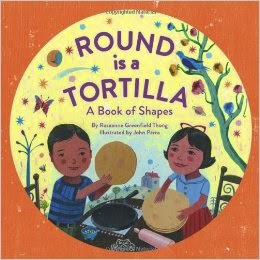
This English language story told in rhyme uses Latino imagery to introduce shapes. Options for extending the story abound - you could have shapes hidden in the room and have a scavenger hunt, you could go on a shape walk around the neighborhood, or you could have a shape sort activity for parents and children to work on together. There is no Spanish only version of this story, so monolingual Spanish language programs will need to replace this book with another title.
"Tortillitas" is a very well-known children's rhyme. I believe that it originates from Mexico, but is also widely known in Central America. If I am mistaken, please leave a comment and let me know! Also, I'm curious if anyone who is from or grew up in the Caribbean or South America can let me know if this rhyme (or a variant of it) is something that you remember from your childhood, or if it is new to you. I know there is a similar version about papas/potatoes. I'd love to hear from you on this topic! There are several versions of the "Tortillitas" rhyme; here are two that I like to use:
Tortillitas, tortillitas, / tortillitas para mamá; / tortillitas para papá. / Las quemaditas para mamá. / Las bonitas para papá. / Tortillitas, tortillitas. Tortillitas de manteca / pa'mamá que está contenta. / Tortillitas de salvado / pa'papá que está enojado.
Here is an English translation that I came up with. The literal meaning has changed in order to maintain rhythm and rhyme: Little tortillas made of wheat / for my mom who is so sweet. / Little tortillas made of corn / for my dad who I adore!
A cumulative story based on the Gingerbread Man that follows a runaway tortilla. Unfortunately no English version of this story is available, so you may want to replace it with one of the titles below in an English language storytime. Alternatively, you can tell this story using the flannelboard.
Ending Activity - Painting Tortillas
Time to get creative! Use tortillas as a canvas and have a paint party! You could encourage children to paint the various shapes or pick a favorite shape to paint in lots of different ways. Another blogger I found suggests keeping the whole activity edible by adding food coloring to water for paint (you could maybe try yogurt as well for different textures) and using lettuce leaves (or corn husks) as brushes!
Last year, Rosana Santana was a student in my class "Bilingual Storytime at Your Biblioteca" offered through Library Juice Academy. She submitted several excellent Spanish translations of rhymes on her final Bilingual Storytime Plans. With her permission, I am sharing those translations here. Thanks, Rosana, for your excellent work and your willingness to share it with your colleagues!
Four Autumn Leaves Cuatro Hojas de Otoño
Four Autumn Leaves Cuatro hojas de otoño
In a big old tree esperando el fin del mes,
One blew off una se cayó
Then there were three y quedaban tres.
Three little leaves Tres hojas de otoño
With nothing to dobailaban en los vientos,
Another blew off otra se cayó
Then there were twoy quedaban dos.
Two little leaves Dos hojas de otoño
In the autumn sun acostadas como en cuna,
One blew off una se cayó
Then there was one y quedaba solo una.
Being all aloneAhí sentada toda sola
Wasn’t much funlas otras hojas la miraron,
The last on blew offla última se tiro
Then there was none y se acabaron.
The Floppy Scarecrow El espantapájaro bailarín
The floppy, floppy scarecrowEl espantapájaro bailarín
Guards his field all dayCuida las plantas todo el día
He wave his floppy (body part)Mueve su (parte del cuerpo)
To scare the crows away!Para espantarar los no confia
Hi everyone! I'm doing something a little different today! Paula Mason, a student in a past session of "Library Outreach and Bilingual Storytime" offered through the Library of Virginia created an absolutely adorable flannel called Freddy Figuras as part of her final project. I love it! So, I asked her to do a guest post to share her work with you all. Enjoy!
I created this flannel board as a simple exploration of how even our faces are composed of several shapes, and even by slightly moving those shapes, we can express different emotions. The felt pieces are very easy to make, and you can be as creative as you’d like with them. I included the following to match with some of the shapes we were discussing in storytime that day:
Un óvalo - la cara
Un triángulo - la nariz
Dos círculos - los ojos
Un semicírculo - la boca
Dos semicírculos más pequeños - las orejas
Dos rectángulos - las cejas
Un cuadro grande - el cuerpo
Los garabatos (varios pedazos de estambre) - el cabello
Tres rectángulos largos y delgados - las rayas del suéter
Dos círculos más pequeños - las pupilas de los ojos
An oval - the face
A triangle - the nose
Two circles - the eyes
A half-circle - the mouth
Two smaller half-circles - the ears
Two rectangles - the eyebrows
A large square - the body
Squiggles (several pieces of yarn) - the hair
Three long and thin rectangles - the stripes on the sweater
Two smaller circles -
the pupils of the eyes
Note: you could also decide to take out some of these pieces depending on the age level of the children, and whether you’d like to extend or shorten the activity.
During the storytime, I mentioned to the children that I wanted to introduce them to a friend, Freddy Figuras, but that we have to first put Freddy together with each shape. I asked the children to help me make the decisions about each shape. Once we have put him together, we also discussed how moving a shape a bit can change his mood, ie. half-circle for mouth turned up=happy, turned down=sad ,and eyebrows turned downward=mad,or upward=curious.
A few of Freddy’s faces—feliz, triste, y enojado (maybe because he lost most of his hair!)
Later, during the play literacy portion of storytime, you could place out all of Freddy’s pieces and let the children make different and unique interpretations of a person or face by using the shapes. You could also place out extra shapes so they have even more pieces to play with.
A very tall Freddy with a big, goofy hat:
As for the books that I paired with this activity, we first read Round is a Tortilla: A Book of Shapes by Roseanne Greenfield Thong, and illustrated by John Parra. We then explored Eric Carle’s bilingual board book: My Very First Book of Shapes/Mi primer libro de figuras. The kids loved both—the rich illustrations in Round is a Tortilla and questions that the author posed, and the fun split pages that make Eric Carle’s book feel like a game. I also did a fingerplay with this activity in which we drew shapes in the air with our fingers. Another idea could be to sing a bilingual version of “When You’re Happy and You know It” after discussing emotions with Freddy’s face. Finally, in discussing the activity with the parents, you could mention the following:
Children can build their narrative skills when being creative, whether they are playing with shapes, drawing, or playing with puppets. By moving the shapes on Freddy’s face, we can begin to craft a story around Freddy and his feelings.
Los niños pueden desarrollar sus habilidades narrativas cuando están usando su creatividad, ya sea que estén jugando con formas, dibujando, o jugando con títeres. Cuando movemos las figuras de la cara de Freddy, podemos empezar a construir una historia acerca de Freddy y sus sentimientos.
¡Mil gracias, Paula, por compartir tus ideas maravillosos con nosotros! Thank you so much Paula for sharing your amazing ideas with us. Happy Storytime!
I am excited to share with you all that a project I have been working on for the last year and a half is finally finished and ready to be used. Day by Day VA is an online family literacy calendar. It was originally created in South Carolina and Virginia took the content and adapted it for their needs. Each day features a song/rhyme, a book, an activity, a video and one or two websites for further information or activities. I was hired in 2013 to create a Spanish language companion site, and it is now complete! You will find in this Spanish language calendar many traditional Spanish-language children's songs and rhymes, as well as made up tunes that piggyback on well-known Spanish and English songs. Each day features a Spanish language or bilingual children's book, with an emphasis on highlighting excellent Latino children's literature, and a video that is either fun for kids or informative for parents. Resources for more activities or further information are linked, including many excellent resources from around the Spanish-speaking world. Though designed for families, the site could be useful for librarians and educators as well. Please take a look and share with customers and colleagues who may find the site useful. If you have a chance, let me know what you think!
Me encanta muchísimo compartir con ustedes un proyecto en el que había trabajado por más que un año. Day by Day VA es un calendario digital de la alfabetización familiar. Lo había creado originalmente en el estado de South Carolina, y el estado de Virgina lo adaptó para la comunidad allá. En cada día hay un libro recomendado, una actividad, un video y uno o dos sitios web recomendados para más información o actividades. La Biblioteca de Virginia me contrató en 2013 para crear un sitio en español para acompañar el sitio en inglés. En el calendario en español, encontrará muchas canciones tradicionales en español, además canciones traducidas que usan ritmos familiares. Cada día presenta un libro para niños en español o bilingüe e incluye muchos autores e ilustradores latinos. Además, muchos sitios web con más información para los padres o actividades divertidas para los niños son incluidos. Este sitio es diseñado para las familias, pero es útil para los bibliotecarios y educadores también. Por favor, explórenlo y compártanlo con clientes y compañeros que pueden usarlo. ¡Si quieren, díganme lo que piensan!
Hi everyone! Just a quick update that this is the last week to register for my next session of "Bilingual Storytime at Your Biblioteca," which is being offered by Library Juice Academy during the month of March. The details are below, and you can register or find more information at the LJA course page - http://libraryjuiceacademy.com/033-storytime-biblioteca.php. Please be in touch if you have any questions; I hope to meet some blog readers in the class group!
Bilingual Storytime at Your Biblioteca
This 4-week, online course teaches participants how to present bilingual storytimes (English/Spanish) for various ages, regardless of their own language skills. Video demonstrations, articles, online resources and course discussions direct students as they learn how to successfully deliver the various elements of bilingual storytimes, either on their own or with a bilingual community partner. Participants will discover new books, rhymes, songs, plans and resources that they can immediately put to use in their bilingual storytime programs.
Learning Objectives:
Students will learn how to select and use the following components in bilingual storytime: books, songs, rhymes, fingerplays, and stories for telling aloud.
Students will experiment with incorporating bilingual materials into their existing storytime programs.
Students will select books and other materials they can use to increase inclusion of Latino culture and the Spanish language in their English storytime programs.
Students will articulate how bilingual storytime supports the early literacy and school readiness needs of Latino children, and identify online resources for sharing early literacy and school readiness information with Spanish-speaking parents.
Students will each develop two bilingual storytime plans.
Occasionally I'd like to highlight an author or illustrator whose works are particularly well-suited for bilingual storytime. This will include Latino authors and illustrators, of course, but also non-Latinos whose works are available either bilingually or in Spanish translation. One of those is Korean author/illustrator Il Sung Na. I first fell in love with Na's works when A Book of Sleep came out in 2009. The illustrations absolutely drew me in. I was over the moon to later find it in Spanish as ZZZZZ Y ellos...¿cómo duermen? The translation absolutely held up and this became a storytime favorite for owls, night and bedtime themes.
Since then, two more of Na's books have become available in Spanish. El escondite is about a group of animals playing hide-and-seek and Brrr El libro del invierno is a winter book. I have my fingers crossed that more are still to come, especially The Thingamabob, which is about an umbrella and would be great for a weather or rain storytime.
Have you used any of Il Sung Na's books in storytime? Tell us about it!
We all know I'm a big fan of John Parra. Unabashedly. I simply love his work. And I am a recent fan of Roseanne Greenfield Thong. She has written a number of books that simultaneously introduce first concepts and celebrate diverse cultures. I have found that her books are very practical for early childhood educators to incorporate into the classroom, and I regularly use them as examples of simple, high-quality diverse children's literature in the workshops that I offer to early childhood educators here in Kentucky. So I am over the moon that these two, who paired up in 2013 to bring us Round is a Tortilla, worked together again to create Green is a Chile Pepper, which received a Pura Belpré honor for illustration at the 2015 Youth Media Awards. As a side note, this year's awards were filled with recognition of diverse authors, illustrators and books. Kudos to all of the committee members. It was thrilling to be a part of this year's announcement.
As anticipated, this title uses Latino imagery, traditional foods and Spanish vocabulary to introduce colors in both English and Spanish. The text is simple, the illustrations are lively and the rhyming text is pleasant to read aloud. This title is a natural fit for storytimes about colors, whether bilingual or not, but can also work for food or family themed programs. This title would also work well in a classroom setting. Educators and librarians can extend the story with a color sort activity, perhaps even as a group on the flannelboard.
Do you have this book in your library or school? Have you read it with your child? What other titles would you pair it with for a colors themed bilingual storytime?
Read more about the Belpre award and its influence in this article recently posted on I Love Libraries.
Hi everyone! This is a quick post just to let you know that there is still time to register for my February class on library outreach to Latino communities being offered through Library Juice Academy. The details are below. One important point is that I strongly encourage taking this class if you are interested in later taking "Bilingual Storytime at Your Biblioteca" (next offered in March). Outreach is a key component of setting a bilingual or Spanish language storytime program up for success. Hope to see some blog readers in the group!
Public libraries across the country experiencing growth in their Latino and Spanish-speaking populations face similar challenges in connecting these communities with library service. Though libraries may offer Spanish-language materials and/or programming, these services may not attract the targeted community as desired. This class is designed to help libraries to bridge the gap and increase the use of their services by Latinos and Spanish-speakers, with particular emphasis on reaching first-generation immigrants and their families. Participants will increase their knowledge of Latino cultural values that impact library use, develop an understanding of common barriers that impede library use, and develop strategies for overcoming those barriers. Participants will also identify key people/organizations within their own communities for potential partnerships. This course is strongly recommended as a prerequisite for “Bilingual Storytime at Your Biblioteca.”
Register here - http://www.libraryjuiceacademy.com/032-spanish-speaking.php.


 This thorough introduction not only gives guidance on how to organize and conduct a bilingual storytime but also details how to do effective outreach to Latinx communities. The book is half manual and half ready-to-use bilingual programs for toddlers, preschoolers, and mixed-age and family groups. The thematic, language-rich plans include songs, finger plays, and extension activities and revolve around titles written by Spanish and Latin American authors and representative of Latino cultures. The how-to section on outreach is chock-full of practical advice on programming and book and app selections. The authors feature real-life examples of librarians visiting community organizations and meeting trusted members of Latinx communities in order to communicate the library’s mission. The authors emphasize the importance of “[embedding] the library as a valued and trusted community service.” Included are literacy maxims in both languages and myths surrounding second language learning. Practical information on how to find and select a bilingual partner and how librarians who are not bilingual can run such programs give this text a greater readership. Much of the advice can be applied to any language group, and an extensive resource list is included.